A State of the Art on Privacy-Preserving Clustering With Missing Data
During my Master’s degree in Computer Science, I conducted a research thesis focused on building a state of the art at the intersection of data analysis, privacy, and cloud computing.
You can read more in these documents [Thesis] · [Poster].
The objective of this work was not to design a new algorithm, but to analyze, compare, and synthesize existing approaches addressing the following question:
How can sensitive and incomplete data be clustered while preserving privacy, particularly in cloud-based environments?
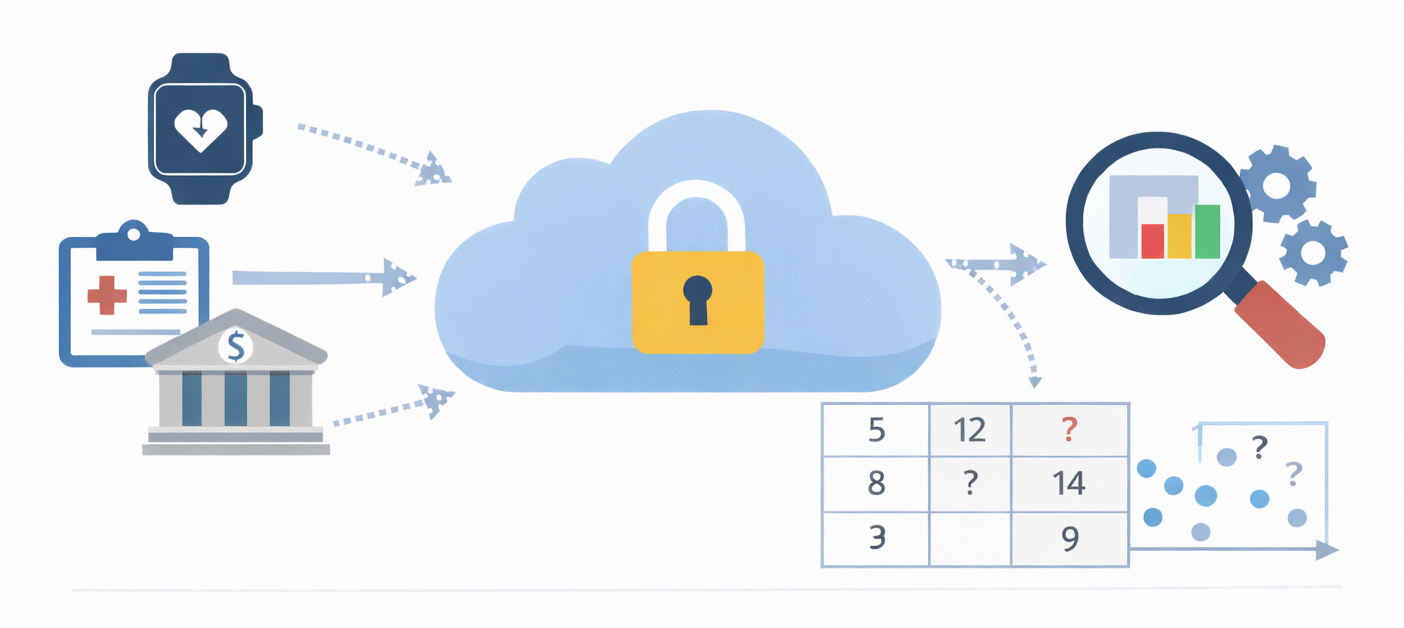
🌍 Why This Topic Matters
Modern digital systems generate massive volumes of data through:
- connected devices (IoT),
- online platforms and services,
- healthcare, industrial, and financial systems.
These datasets are often:
- sensitive, requiring strong privacy guarantees,
- incomplete, due to missing measurements or failures,
- processed on external cloud infrastructures.
This creates a fundamental tension between data usefulness and data confidentiality.
📚 Scope and Outcomes of the State of the Art
This work presents:
- a survey of clustering methods handling missing data,
- a review of privacy-preserving clustering approaches based on homomorphic encryption,
- a comparative analysis of their assumptions, limitations, and trade-offs.
By confronting these approaches with real-world constraints, the thesis highlights several open gaps between theoretical solutions and practical deployment.
🔎 Identified Research Gaps
The state-of-the-art analysis reveals:
- limited support for missing data in encrypted clustering methods,
- high computational overhead introduced by cryptographic operations,
- simplifying assumptions that do not hold in realistic system settings.
These gaps motivated further work beyond the scope of this thesis, see my article on my engineer thesis for more informations.
🚀 Conclusion
This thesis established a conceptual and technical foundation for understanding the challenges of privacy-preserving data clustering in realistic environments.
By identifying unresolved issues and practical limitations, it naturally opened the way for subsequent applied and engineering-oriented work, presented separately in this article.
